Context
The causes of the Revolution were multiple and complex. France under Louis XVI faced severe financial difficulties, worsened by the expense of supporting American independence. The tax system exempted privileged orders while burdening the peasantry and bourgeoisie. A series of bad harvests in the late 1780s raised bread prices and popular discontent. Meanwhile, Enlightenment ideas about natural rights, social contract, and the critique of traditional authority had spread among educated classes. When the king convened the Estates-General in May 1789 to address the financial crisis, he set in motion a chain of events he could not control.
The transformation of the Estates-General into the National Assembly in June 1789 marked the beginning of revolutionary change. Representatives of the Third Estate, joined by sympathetic clergy and nobles, claimed sovereign authority to write a new constitution for France. The Tennis Court Oath, in which deputies pledged not to disperse until their task was complete, symbolised this assertion of popular sovereignty against royal prerogative. Within weeks, the fall of the Bastille on 14 July demonstrated that the people of Paris stood ready to defend the Revolution by force.
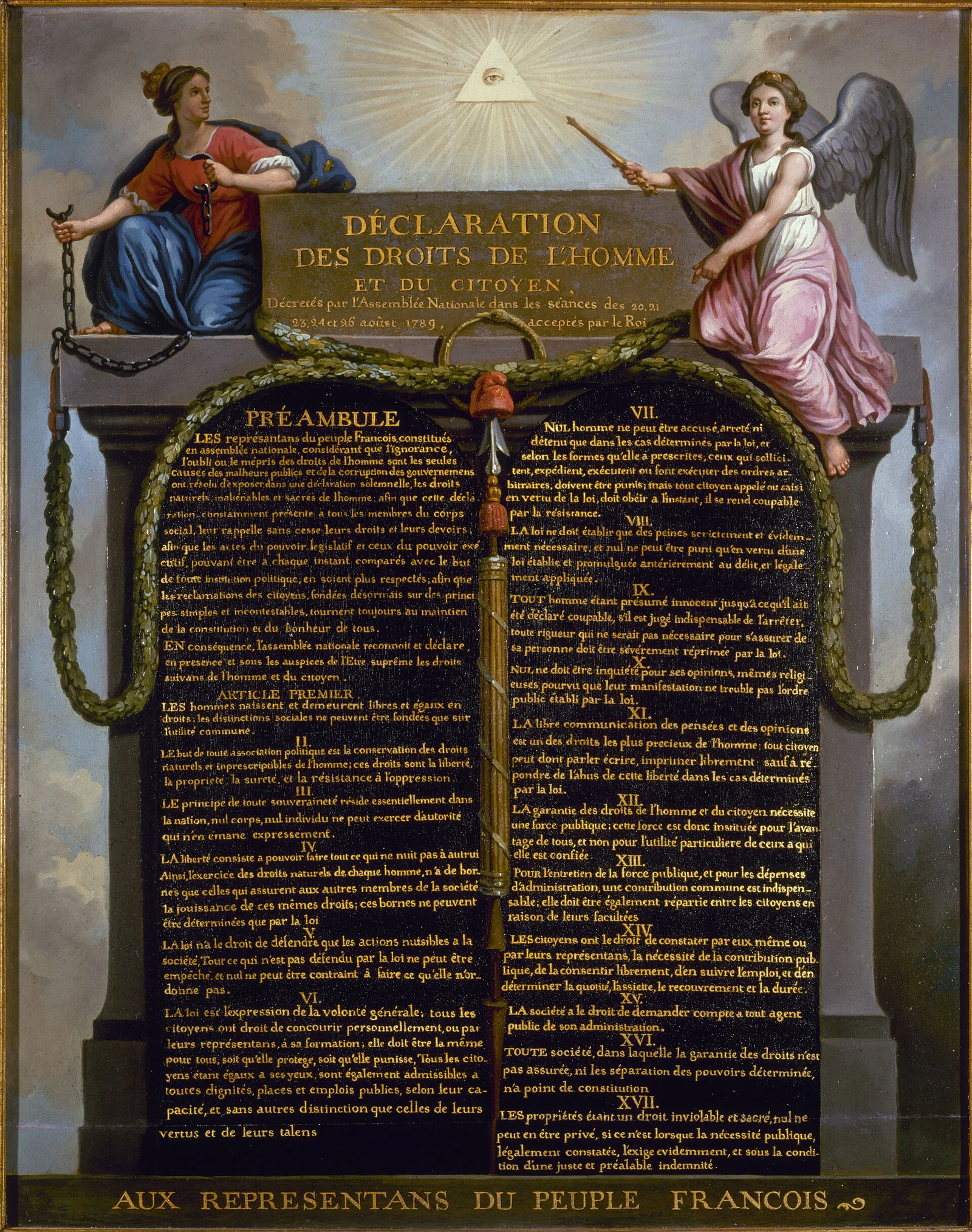
The Declaration of the Rights of Man and of the Citizen, adopted in August 1789, articulated the Revolution's foundational principles. Drawing on Enlightenment philosophy and American precedents, it proclaimed that men are born and remain free and equal in rights, that sovereignty resides in the nation rather than the king, and that liberty, property, security, and resistance to oppression are natural and imprescriptible rights. These principles, while initially limited in application, provided a standard against which all subsequent social arrangements could be measured.
The first years of the Revolution witnessed attempts to create a constitutional monarchy that would preserve the king while limiting his powers. The Civil Constitution of the Clergy, which subordinated the Catholic Church to the state, created deep divisions that would fuel counter-revolution. The royal family's attempted flight to Varennes in June 1791, and their forced return to Paris, fatally damaged the king's legitimacy. When France went to war with Austria and Prussia in April 1792, military setbacks combined with political radicalisation to sweep away the constitutional settlement.
What to Notice
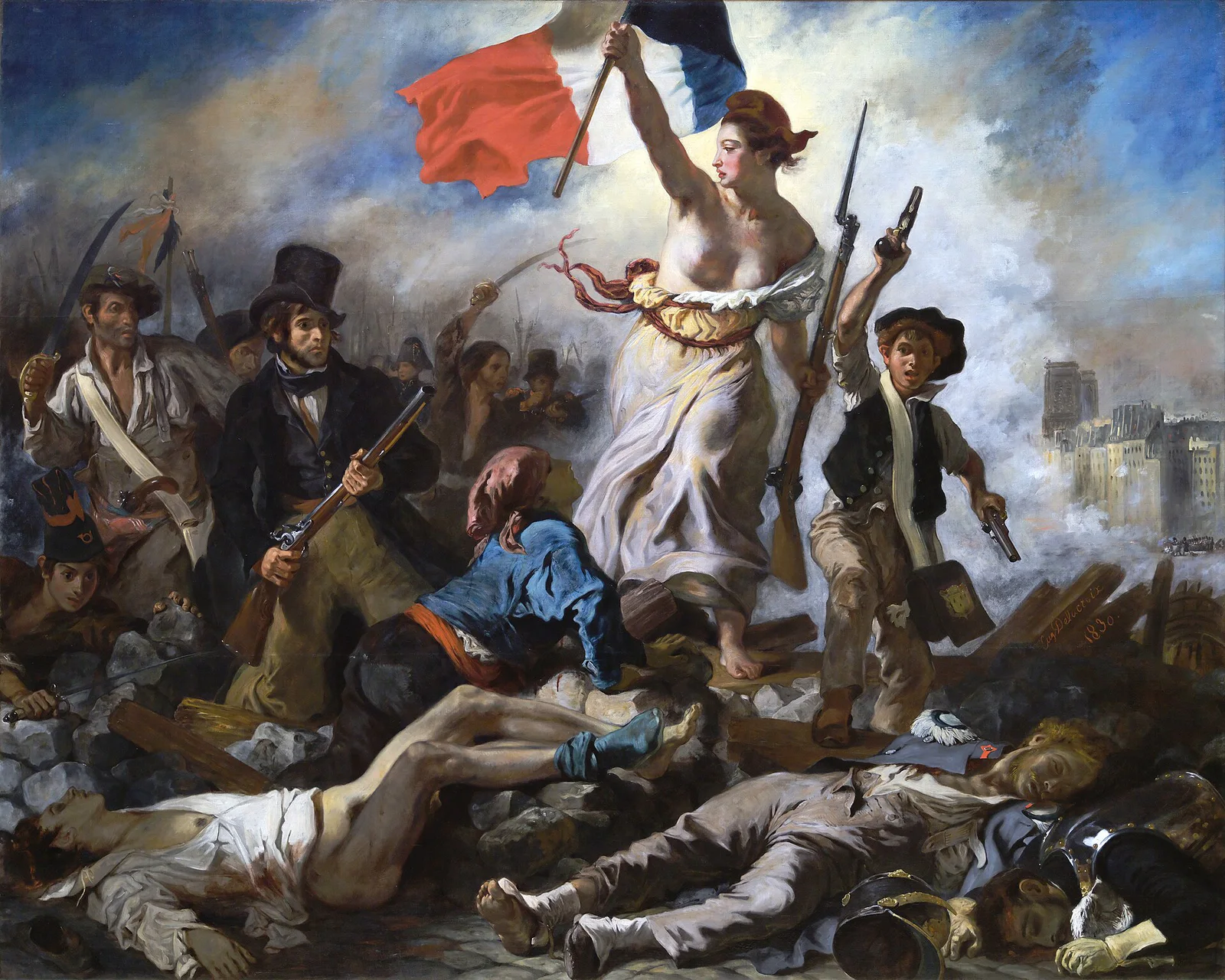
The article's hero image does not show 1789 itself but Delacroix's Liberty Leading the People, painted after the July Revolution of 1830. That later date matters. The canvas is not evidence for the French Revolution in a documentary sense; it is evidence for the way the Revolution was remembered, mythologised, and visually reimagined in nineteenth-century France. Liberty strides forward as an allegorical figure rather than a historical witness, reminding the viewer that the Revolution quickly became a political language of symbols as much as a sequence of events.
The slideshow begins more directly with Jacques-Louis David's unfinished Tennis Court Oath, an image built around collective resolve. The deputies are not arranged as passive sitters but as a crowd unified by gesture, oath, and momentum. From there the visual sequence moves to the storming of the Bastille and to the engraved heading of the Declaration of the Rights of Man and of the Citizen. These images shift the emphasis from insurrection to political principle: fortress, assembly, and text together show how the Revolution joined street action to constitutional language.
The later slides darken the narrative. The execution of Louis XVI, the print of the Girondins, and David's Death of Marat show how quickly revolutionary legitimacy became entangled with death, sacrifice, and public theatre. The guillotine appears not only as an instrument of punishment but as a sign of sovereignty turned against former rulers and former allies alike. Taken together, the visual programme asks the reader to notice a progression from hope and collective declaration to martyrdom, coercion, and the unstable politics of virtue.
Points of Interest
The proclamation of the Republic in September 1792 and the execution of Louis XVI in January 1793 marked a point of no return. The Revolution had become regicide, challenging not merely one king but the principle of monarchy itself. War with most of Europe, civil war in regions like the Vendée, and economic crisis created an atmosphere of emergency that justified increasingly radical measures. The Committee of Public Safety, dominated by Robespierre and his allies, centralised power in the name of saving the Revolution from its enemies.
The Terror of 1793-1794 represented the Revolution's most violent phase. Revolutionary tribunals sent thousands to the guillotine, from the queen Marie Antoinette to revolutionary leaders who fell from favour. The Jacobin programme sought to remake French society fundamentally, introducing a new calendar, promoting a revolutionary religion, and pursuing virtue through purges. Yet the Terror also mobilised the nation for war, creating the mass armies that would defeat the foreign coalition and carry revolutionary ideals across Europe. Its violence remains the subject of ongoing historical debate about revolutionary necessity and excess.
The fall of Robespierre in July 1794 ended the Terror but not the Revolution. The subsequent Thermidorian reaction and Directory period saw attempts to stabilise a republic that remained threatened from both royalist and radical directions. Economic difficulties, military challenges, and political instability undermined successive governments. The Constitution of 1795 created a complicated system that satisfied few and convinced many that stronger leadership was needed. The ground was prepared for the rise of Napoleon Bonaparte.
Napoleon's seizure of power in November 1799 marked both the end of the Revolution and its continuation by other means. The Napoleonic regime consolidated many revolutionary achievements, including legal equality, administrative centralisation, and the abolition of feudal privileges, while abandoning others such as political liberty and parliamentary government. The Revolution's longer legacy proved even broader: it established a durable model of revolutionary transformation, connected legitimacy to the nation rather than dynastic right, and forced modern politics to confront the unresolved tension between liberty, equality, representation, and violence.