Context
The Dutch Golden Age, spanning roughly 1580 to 1680, coincided with the young Republic's emergence as a global trading power. The Dutch East India Company (VOC), founded in 1602, funnelled capital into Amsterdam, transforming it into Europe's wealthiest city. Unlike the court-centred patronage systems of France or Spain, the Republic's art economy was driven by a broad bourgeois market: merchants, guild officials, surgeons, and civic militias all commissioned paintings. This decentralised demand encouraged specialisation—still life, marine painting, architectural interiors—and rewarded artists who could satisfy middle-class taste while elevating it. The sheer volume of production was remarkable; historians estimate that several million paintings were created in the Dutch Republic during this century, a figure that underscores the depth of the market Rembrandt entered.
Rembrandt arrived in Amsterdam from Leiden around 1631, already trained in the fine-manner style of his teacher Pieter Lastman. He quickly secured portrait commissions from the city's professional elite, establishing a large workshop that trained pupils such as Ferdinand Bol and Govert Flinck. His early Amsterdam career was marked by rapid commercial success: fashionable portraits, dramatic history paintings, and a growing reputation as an etcher whose prints circulated across Europe. The workshop model itself was integral to his practice; pupils copied the master's compositions, assisted with backgrounds, and absorbed a pictorial vocabulary rooted in chiaroscuro and narrative intensity.
Yet Rembrandt's relationship with the market was turbulent. His purchase of a grand house on the Sint Anthonisbreestraat in 1639 burdened him with debt; by 1656 he was declared insolvent. His later style—thicker impasto, looser handling, deeper psychological gravity—alienated some patrons even as it attracted others who prized the very qualities that unsettled conventional taste. The tension between artistic independence and economic reality runs through his biography and through the broader story of Dutch Golden Age painting, where the freedom of a market economy could empower and constrain in equal measure.
What to Notice
Two works in particular reward close visual attention for what they reveal about Rembrandt's methods and the civic culture that sustained them.
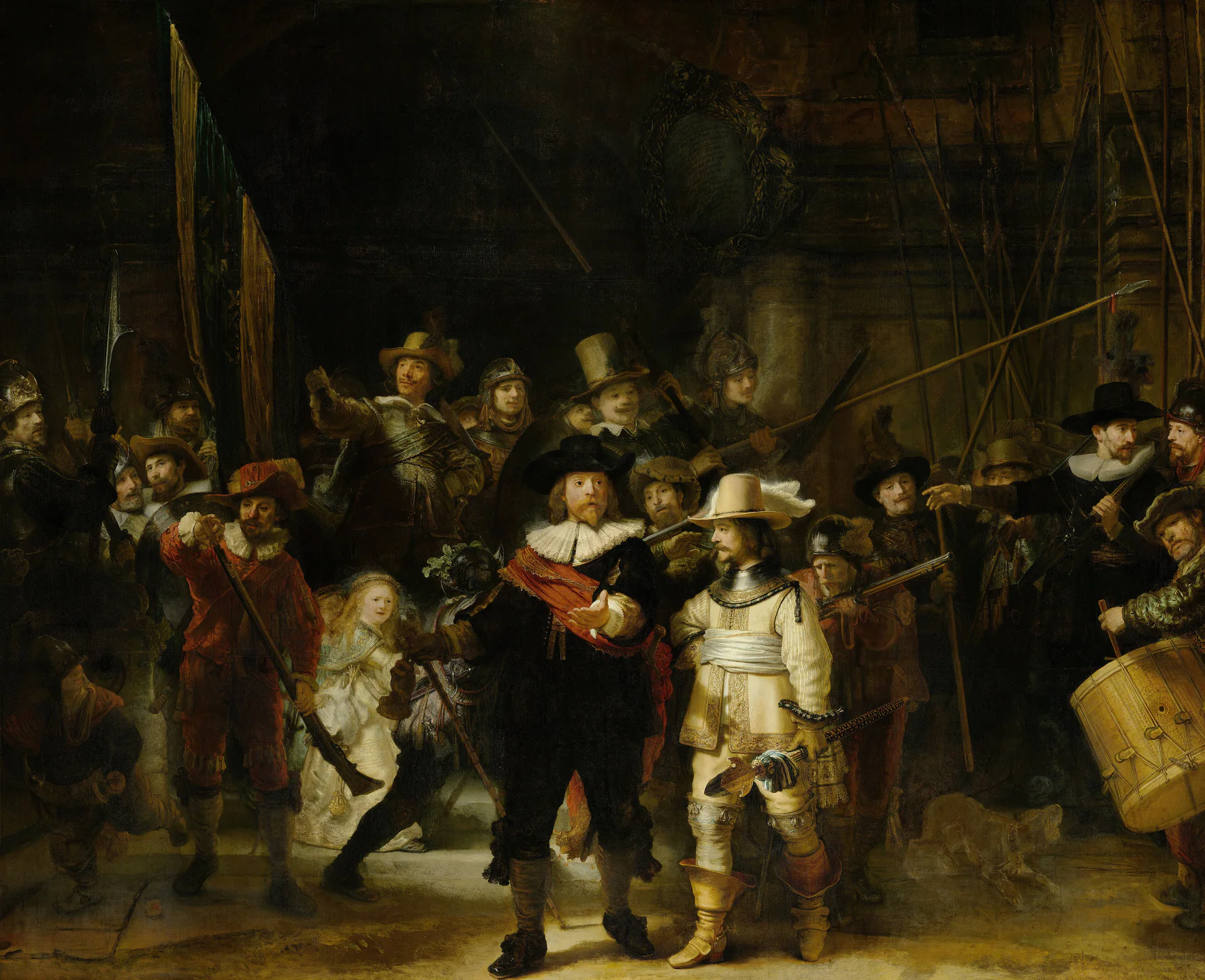
*The Night Watch* (1642), the monumental militia portrait now in the Rijksmuseum, upends the conventions of group portraiture. Where standard practice arranged sitters in orderly rows to ensure each paying member received equal prominence, Rembrandt staged the company of Captain Frans Banning Cocq as a burst of theatrical action. The captain strides forward, his outstretched left hand casting a shadow across the lieutenant's bright yellow coat—a shadow that is itself a virtuoso exercise in tonal modelling. Light falls selectively: a young girl in a golden dress glows near the centre, her function in the composition still debated by scholars, while figures at the margins dissolve into darkness. The painting's enormous scale (363 × 437 cm) and its dramatic chiaroscuro transform a civic obligation into a history painting in all but name. Notice how the overlapping figures create depth through occlusion rather than linear perspective, a strategy that sacrifices individual legibility for collective energy. It is worth pausing, too, over the variety of textures Rembrandt renders within a single canvas—polished metal, embroidered fabric, soft plumes—each handled with a different quality of brushwork that rewards prolonged looking.
*The Sampling Officials* (1662), painted two decades later for the Amsterdam Drapers' Guild, offers a revealing contrast. Here five syndics and their attendant are seated around a table covered with a rich oriental carpet, their gazes directed outward as though interrupted mid-deliberation. The composition is deceptively simple—a horizontal frieze of dark-clad figures against a panelled wall—but Rembrandt animates it through subtle asymmetries: one official half-rises from his chair, another leans slightly forward, and the attendant stands bareheaded behind. The restrained palette of blacks, browns, and deep reds concentrates attention on faces and hands, where the paint is applied with a directness that anticipates nineteenth-century realism. Where *The Night Watch* dramatises, *The Sampling Officials* distils, yet both paintings share Rembrandt's insistence on psychological presence over decorative arrangement.
Across both canvases, observe how Rembrandt manipulates the viewer's position: in *The Night Watch* we are bystanders to a spectacle; in *The Sampling Officials* we are the audience the syndics address. This shifting relationship between painting and viewer is central to Rembrandt's enduring power and helps explain why his work continues to feel immediate centuries after its creation.
Points of Interest
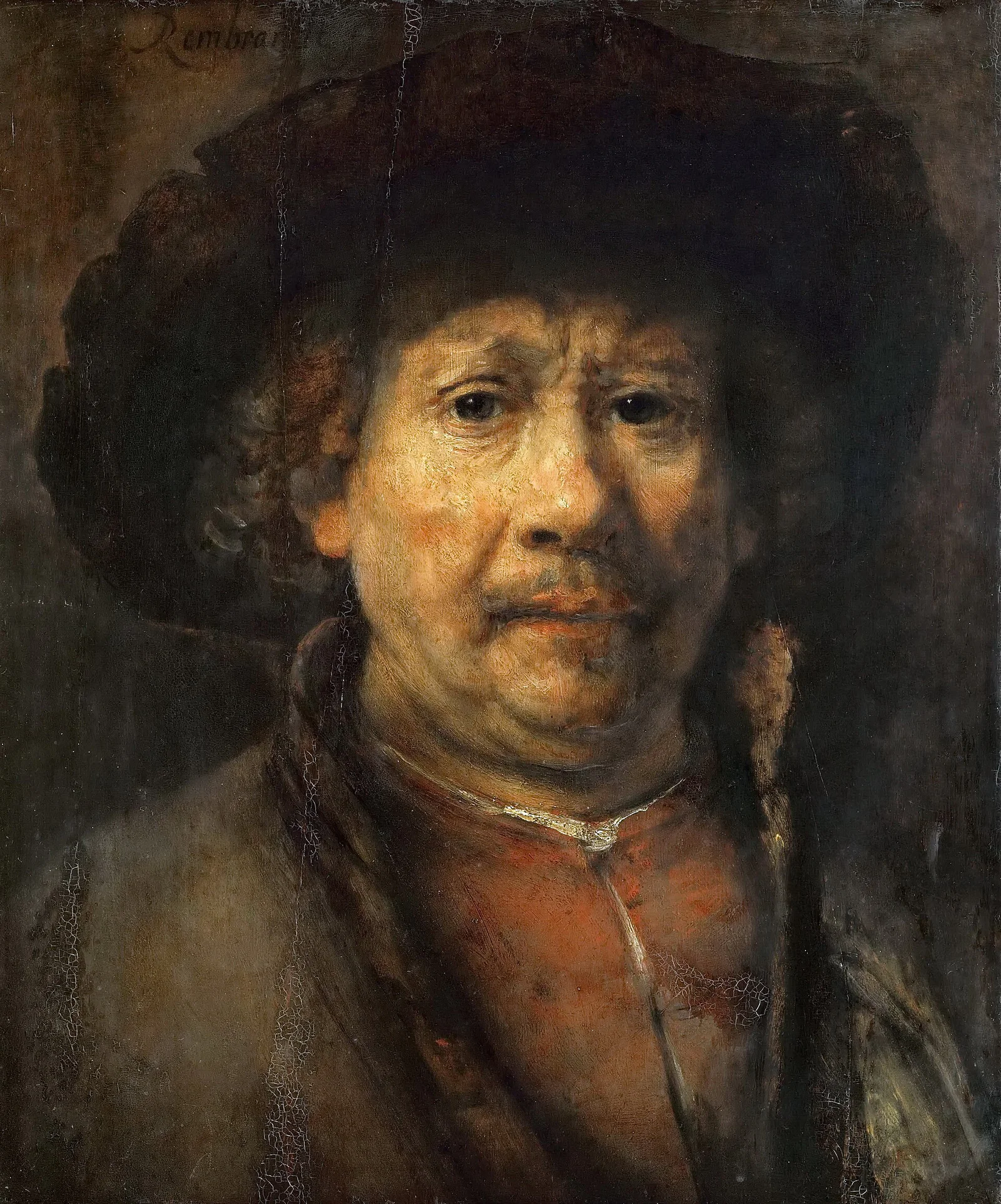
Rembrandt's self-portraits—over eighty across painting, etching, and drawing—constitute the most sustained programme of artistic self-examination before the modern era. The late *Self-Portrait* of 1661 shows the artist in a plain cap and working clothes, his face modelled with broad, loaded strokes that leave the weave of the canvas visible. It is neither flattering nor self-pitying; it is an empirical record of ageing rendered with the same attentiveness he brought to any commissioned sitter. Taken together, the self-portraits chart not only the physical passage of time but also the evolution of Rembrandt's technique, from the smooth, meticulous surfaces of his Leiden years to the rough, almost sculptural impasto of his final decade.
His *Anatomy Lesson of Dr Nicolaes Tulp* (1632), painted shortly after his arrival in Amsterdam, demonstrates how portraiture, scientific inquiry, and urban prestige converged in the Republic. The composition places the praelector at the right, forceps in hand, while seven observers crowd around the cadaver with expressions ranging from rapt attention to performative gravity. The painting secured Rembrandt's reputation among Amsterdam's professional classes and established a template for the scientific group portrait that persisted for generations. Collections at the Cleveland Museum of Art and the Art Institute of Chicago hold significant examples of Rembrandt's graphic work—etchings and drawings that further illuminate his restless experimentation with line, tone, and narrative across every medium he practised.